1. Billing: automate up to 3 invoice debt reminder emails
Section titled “1. Billing: automate up to 3 invoice debt reminder emails”Set reminder schedules in Billing settings, customize email content under Invoice templates, and optionally disable reminders per client. No email is sent if the day count is 0 or empty.
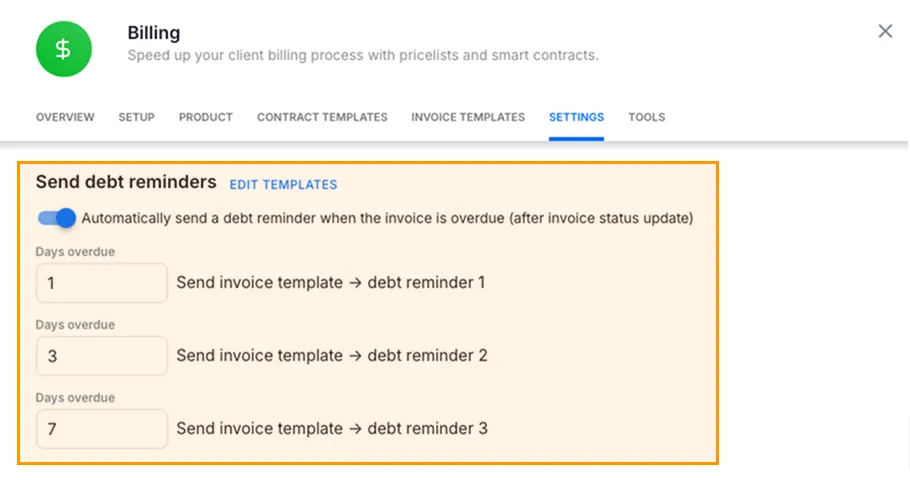
Example: Trigger reminders at 1, 3, and 7 days past due to speed collections without manual follow-up and cut admin time.
2. Billing: personalize reminder emails with invoice placeholders
Section titled “2. Billing: personalize reminder emails with invoice placeholders”Use {{client_name}}, {{seller_name}}, {{invoice_number}}, {{invoice_date}}, {{due_date}}, {{overdue_days}} in templates to auto-fill critical context and minimize editing.
Example: Insert client name and overdue days to make actions clear and lift response rates while saving prep time.
3. Billing: choose the client’s “Primary member” as the default billing resource
Section titled “3. Billing: choose the client’s “Primary member” as the default billing resource”Uku resolves the billing resource across five levels: 1) Invoice line, 2) Contract service, 3) Product, 4) Client default, 5) Company default; client- and product-level overrides are supported.
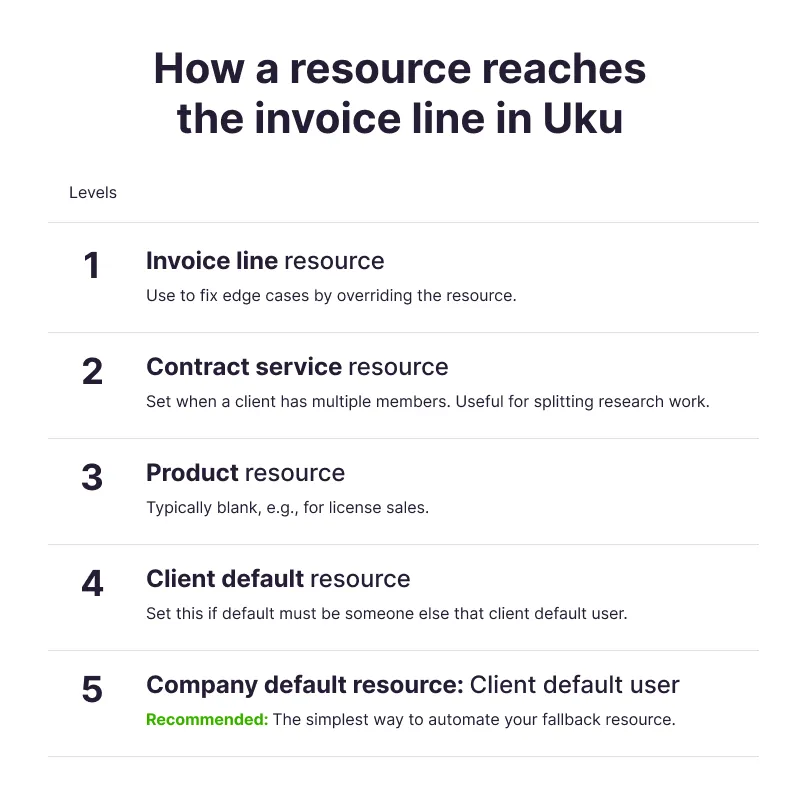
Example: Route consulting hours to the client’s lead accountant by default, while mapping software licenses to a product-level resource for accurate realization and reporting.
4. Integration: Directo client sync and invoice export
Section titled “4. Integration: Directo client sync and invoice export”Import clients and contacts from Directo into Uku, create invoices in Uku, and export them back to Directo. Optionally fetch payment status and send reminders for unpaid invoices from Uku.

Best practice: Track work volumes separately (time, document counts, payroll runs) and invoice from Uku so you can analyze volumes later and refine pricing.
5. Tasks: bulk update client workflow from company task templates
Section titled “5. Tasks: bulk update client workflow from company task templates”Select which clients, tasks, and checklist fields to update. Client-specific customizations are overwritten and changes are captured in the audit log.
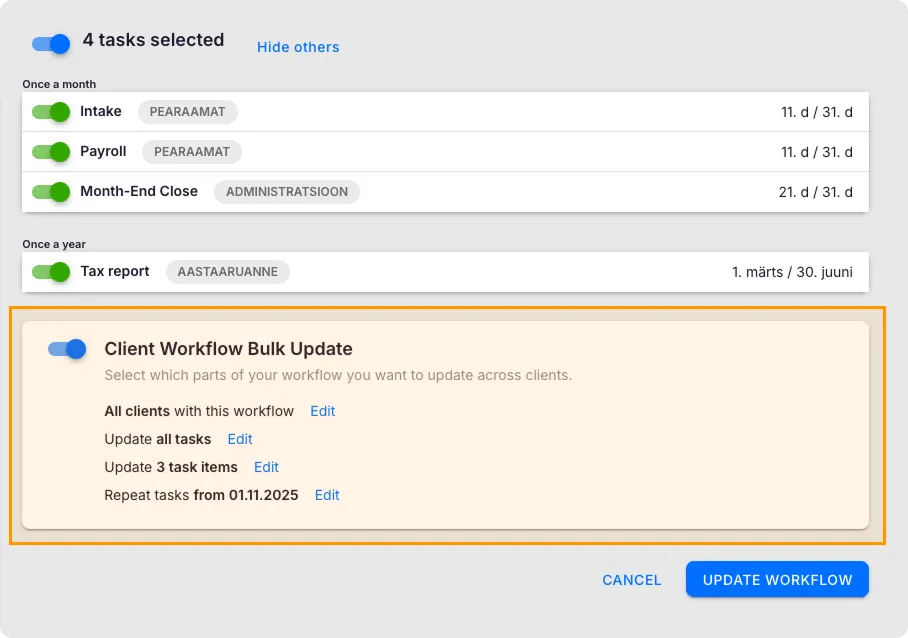
Example: Roll out updated monthly bookkeeping checklists across the firm after tax season and keep workflows consistent.
6. Tasks: bulk update of start dates in client workflow
Section titled “6. Tasks: bulk update of start dates in client workflow”Set “Repeat tasks from” to a past month to generate tasks into the past. When changing an existing plan, Uku deletes prior New-status tasks and recreates them per the new recurring rules.
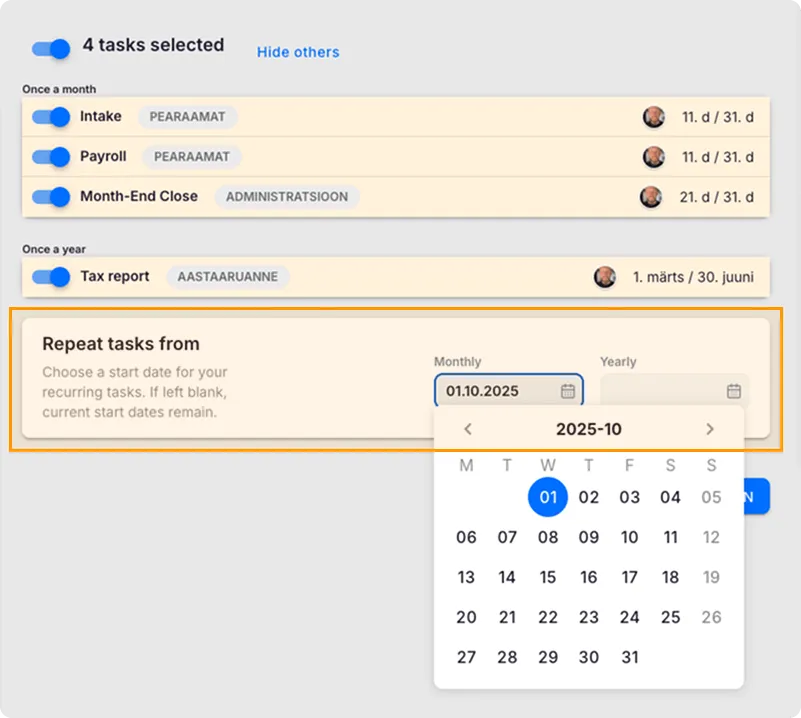
Example: Create 3 months of accounting tasks for a new client to accurately track time and work completed.
7. Projects: track project process statuses at a glance in the list
Section titled “7. Projects: track project process statuses at a glance in the list”See and filter projects by process status to spot bottlenecks and drive progress across engagements.
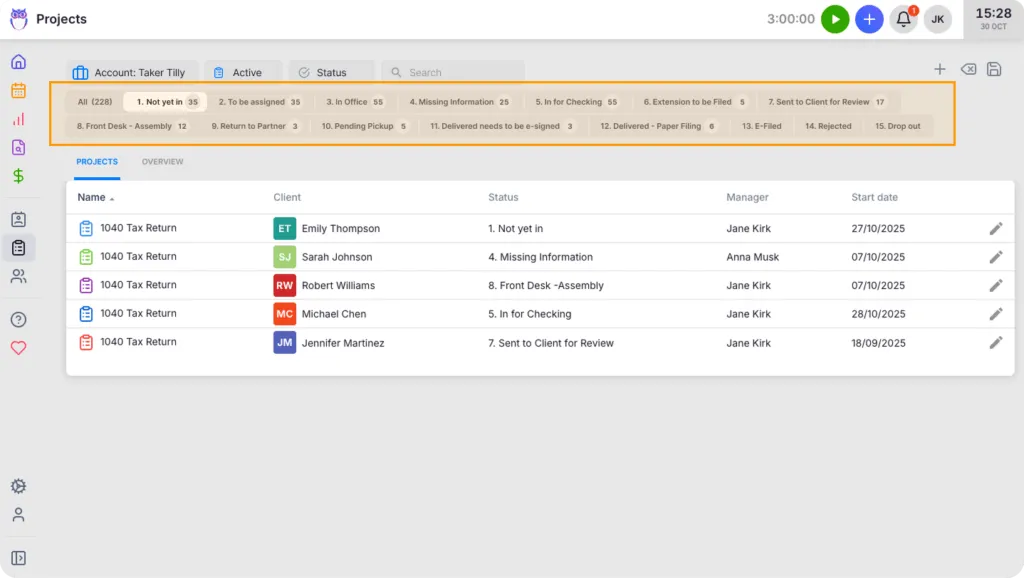
Example: Identify Tax Return projects marked “Awaiting approval” and nudge clients to accept the advance invoice.
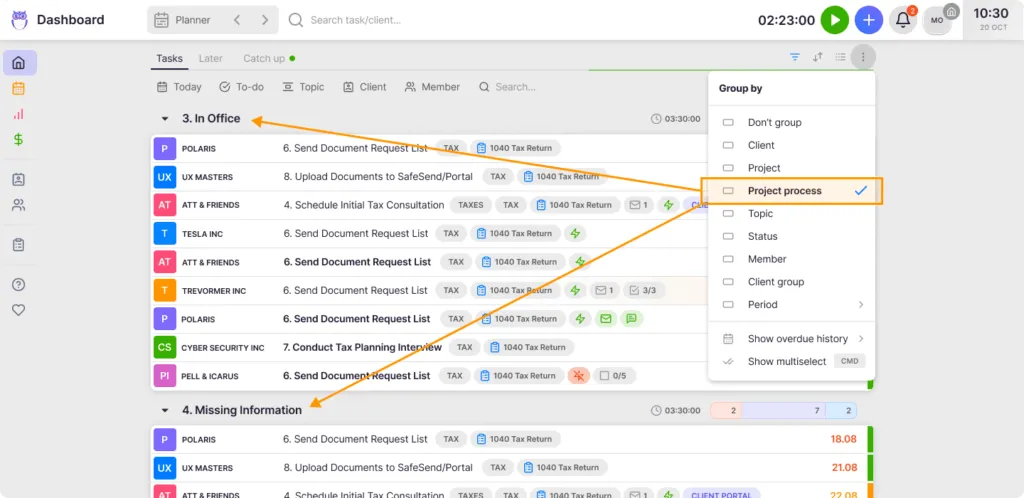
8. Dashboard: group project tasks by process status and filter consistently
Section titled “8. Dashboard: group project tasks by process status and filter consistently”Use the same process-status grouping and filters in Dashboard, Client tasks, Project tasks, and Reports for focused work.